
India Through The Postcard
India Through The Postcard
1879-1947
Postcards offer a unique visual record of India’s colonial past—capturing cities, landscapes, monuments, and everyday life as seen through the eyes of printers, photographers, travellers, and postal systems.
India Through the Postcard is conceived as a visual archive of colonial India, approached through the medium of the picture postcard. These objects are treated not as collectibles alone, but as historical documents—bearing evidence of image-making, circulation, and reception within British, French, and Portuguese India.
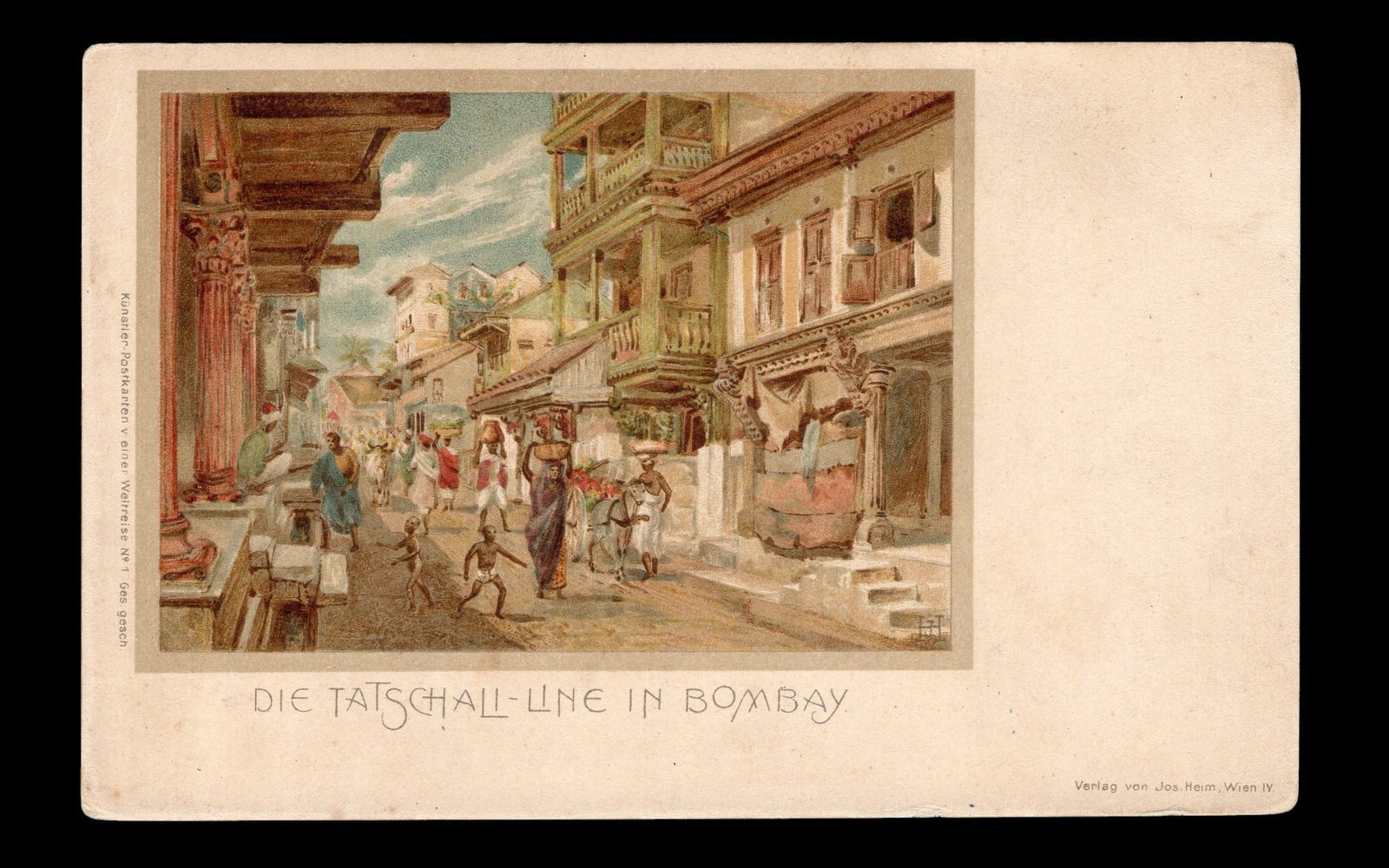
Die Tatschali Line In Bombay
Art: Josef Hoffmann | Print: Josef Heim, Vienna | 1898
Introduction
Picture postcards occupy a crucial position in the postal and visual history of India. Emerging at the intersection of colonial administration, commercial printing, and expanding postal networks, postcards were both utilitarian objects of communication and instruments of representation. In the Indian subcontinent, the development of the picture postcard coincided with the consolidation of imperial postal systems and the rise of mass visual culture between the late nineteenth century and the Second World War.
British India
Early Adoption and Postal Regulations
Postcards were officially introduced in British India on 1 July 1879, following earlier experiments in Austria-Hungary and Britain. Initially, only plain government postcards were permitted, printed and sold by the Indian Post Office. Illustrated or privately produced postcards were not allowed for postal transmission until regulatory changes in the 1890s.
The decisive shift occurred in 1898, when the Indian Post Office formally permitted privately printed postcards, provided they adhered to size, layout, and message restrictions. This regulatory change catalysed the emergence of the picture postcard industry in India.
Production and Publishing Centres
The majority of early picture postcards depicting India were:
Printed in Europe (notably Germany, Britain, and Austria)
Commissioned by Indian publishers, booksellers, or photographers
Often distributed through colonial urban centres such as Bombay, Calcutta, Madras, Lahore, and Simla
German chromolithography dominated postcard production until the outbreak of the First World War, after which British and Indian printers increasingly filled the gap.
Common publishers included:
Bourne & Shepherd (photographic origins)
Higginbotham & Co.
Thacker, Spink & Co.
Raphael Tuck & Sons (UK-based but India-focused series)
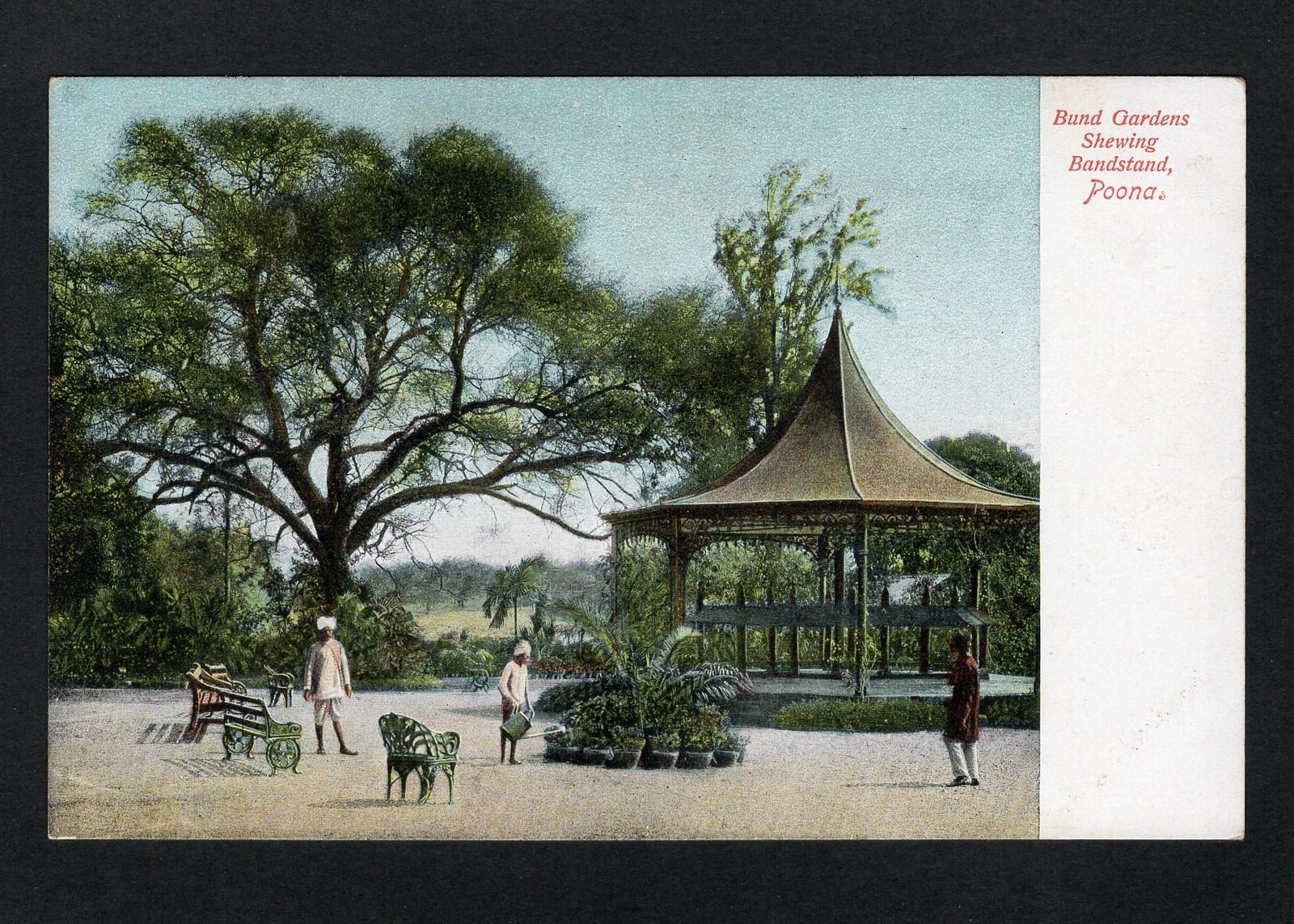
Bund Gardens Shewing Bundstand. Poona.
Art: Unknown | Print: G.B.V. Ghoni, Bombay | Germany | 1900
Postal Usage and Rates
Picture postcards in British India were subject to the same postal tariffs as plain postcards:
¼ anna inland rate (later revised)
Higher rates for foreign destinations, depending on UPU agreements
Key postal features of interest include:
Divided-back postcards (officially allowed from 1905)
Field Post Office usage during military campaigns
Railway Travelling Post Office (RMS) cancellations
Early airmail endorsements on late colonial cards
Thematic and Administrative Significance
Postcards served as visual records of:
Imperial architecture and urban planning
Ethnographic “types” and occupational studies
Railways, ports, and infrastructure
Princely states and durbar ceremonies
French India
Postal Administration and Card Usage
French India—comprising Pondichéry, Karikal, Mahé, Yanaon, and Chandernagore—operated under a distinct postal administration aligned with metropolitan France, while simultaneously interacting with British Indian postal routes.
Picture postcards were permitted relatively early and followed French postal conventions, including:
French language inscriptions
Use of centimes and francs
Adherence to French postcard formats
Publishing and Iconography
Most postcards of French India were:
Printed in France
Issued by metropolitan publishers or colonial administrators
Photographically derived, often understated in tone
Popular subjects included:
Colonial administrative buildings
Catholic missions and churches
Indo-French street life
Port scenes and coastal views
Unlike British India, large-scale commercial postcard publishing within French India itself remained limited.

Postal Markings and Routes
Postal historians value French India postcards for:
Distinctive French colonial cancellations
Maritime mail routes via Colombo or Marseille
Dual usage in Indo-French correspondence
Cards sent within India but originating from French territories often demonstrate complex routing, reflecting overlapping imperial postal sovereignties.
Portuguese India
Portuguese India—primarily Goa, Daman, and Diu—maintained a conservative and highly regulated postal system. Picture postcards appeared later and in smaller quantities compared to British India.
Postcards adhered to:
Portuguese postal formats
Denominations in reis and escudos
Regulations defined by Lisbon rather than local authorities
Production and Distribution
Most picture postcards of Portuguese India were:
Printed mostly in Portugal
Issued by colonial presses or Catholic institutions
Photographically restrained, often architectural or ecclesiastical
Subjects commonly included:
Churches and convents
Administrative buildings
Riverfronts and harbours
Catholic religious processions
Commercial postcard publishing was limited, making genuinely used examples scarcer.
India Through The Postcard Collection
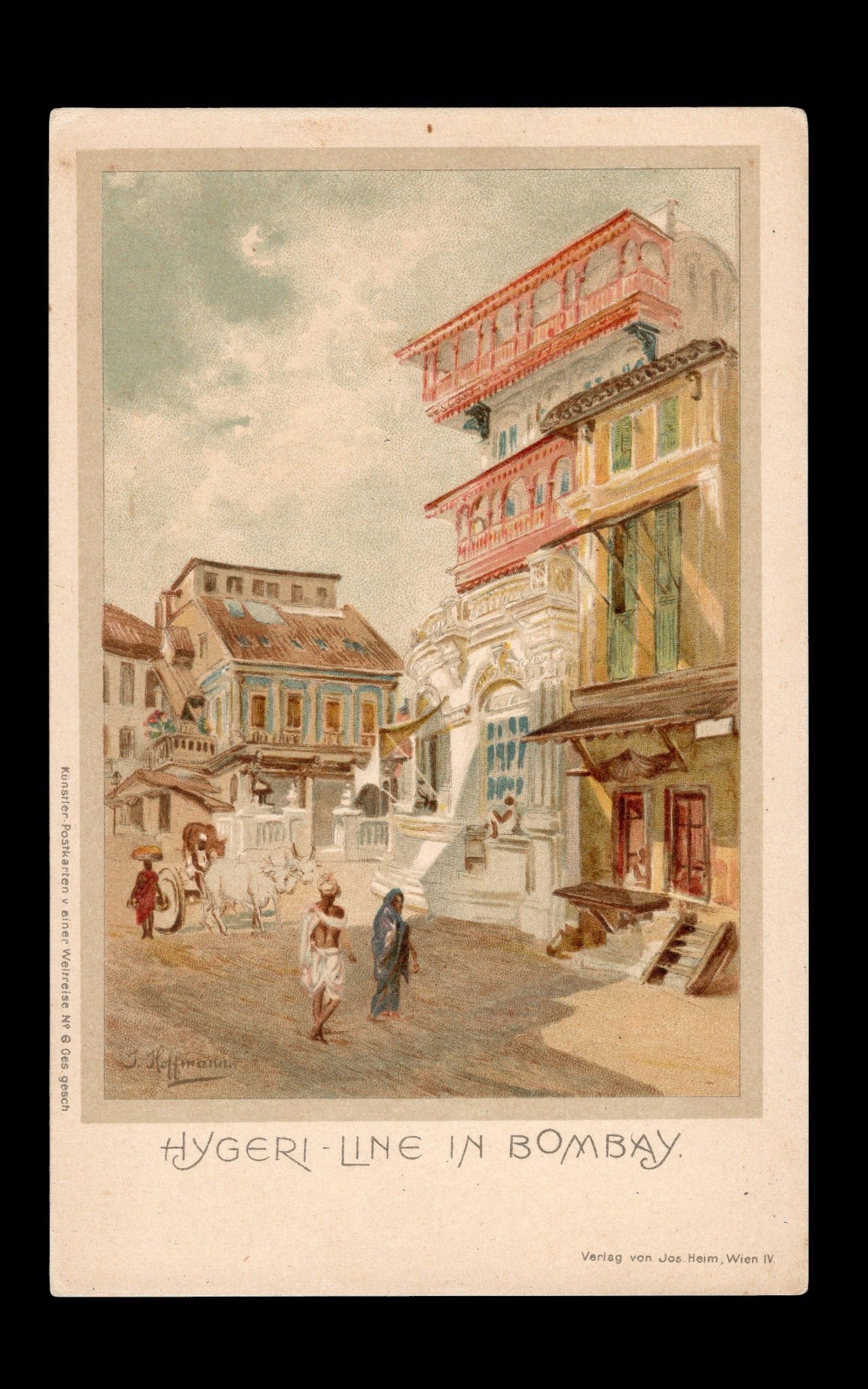
Hygeri Line In Bombay
This is a vintage postcard titled “Hygeri-Line in Bombay” from a painting by Austrian artist Josef Hoffmann. The chromolithograph postcard was published in 1899 by Josef Heim in Vienna, part of a rare series depicting scenes from Hoffmann’s tour of India.
Tatschali Line In Bombay
Die Tatschali Line in Bombay is a vintage postcard, specifically one of the “Künstler-Postkarten von einer Weltreise” (Artist Postcards from a World Tour) series, depicting a street scene in Bombay (now Mumbai).
All stamp images and content © PhilatelyLife